Tuesday, November 5, 2019

Do Not Go Gentle...

Sunday night I drank hard
I was celebrating friendships rekindled 
and mourning friendships lost 
and mourning the passing 
of friends who are no longer here‬
‪I drank hard enough to spend 
the early hours of morning 
huddled over a porcelain alter
‪I was lucky enough to have a friend 
holding my hair as I paid my raging tribute


‪Thanks to everyone at World Fantasy 2019‬

Friday, February 8, 2019

Cary Heater: bookseller and friend


Cary Heater
1961-2019

Cary was a bookseller. She had eclectic tastes that probably did not match your own, but she was a pro, who knew how to find just the right book for you. She could nimbly jump from genre to genre… when Borderlands was threatening to close, she gamely started working at a mainstream bookstore over at the Ferry Building. One that catered to the tourist crowd. She knew what they liked. She like to talk about them….  She always liked to talk. Not trash-talk exactly. She was never mean. But she didn’t suffer fools. At all.

She was a beast when it came to dealing with distributors and publishers and returns and orders. She just handled it. For many years, she was the reason the books got on the shelves, week after week.

She had a love hate relationship with computers, and that included the Borderlands computers and inventory database. But again, she could bull through it, and just get the job done. She might let you know how persnickety the computer was being, or how frustrating Baker & Taylor was being, or tell you exactly what the publisher had done to screw up the shipment that needed to arrive the next day for an author event, but all that was just the background music to her day. She would see a pile of work and plow through it until it was done.

She was a true San Franciscan. She drank at The City’s drag-bars and loved the people who made them their home. She prowled the streets of Hayes Valley and The Mission after dark, reading in bars and restaurants and generally being exactly the kind of literate San Francisco hedonist that the city is known and loved for.

When I brought my kids into Borderlands, they would swarm behind the counter, and I would always tell them to listen to Auntie Carey – to ask if they could go back there.  She didn’t particularly like kids, but she took a bit of quiet, perverse delight in being called Auntie. Her chuckle when I would say “Auntie Cary” was always there, and I can hear it now.

I enjoyed having her tell me about what she was reading because her tastes were very different from mine. I always enjoyed listing to what drew her to a particular title, or why a book did or did not work for her. She trusted me, in the way booksellers and other intimates trust each other – to NOT kink-shame each other for their reading habits.  Borderlands was a safe space in that regard, and she helped keep it that way.

When she was having an especially exasperating day, I would hug her, and tell her everything was going to be fine. Usually the computer just needed to be rebooted.
I wish I had hugged her more.

Friday, November 11, 2016

Hillary Clinton’s Maginot Line (or How Do We Fight and Win Tomorrow's Political Battles?)


Generals who plan to fight the previous generation’s war are bound to lose. Hillary Clinton had 8 years to crate a presidential campaign, and she spent 8 years building a political Maginot line.
Hillary’s primal political experience at the national level was the DLC of the 90s. After being kicked around by Regan's Republican Party, the Democratic Party essentially followed the “New Labor” model of cozying up to big business and the moneyed elite, at the expense of the working class And labor unions. Essentially the DLC Democrats split the baby in half, trying to be “Republican Light”… pro business, but with liberal social values. And with the charismatic Bill Clinton leading it, this was enough to keep the executive branch, even if it meant losing legislative branches of the government.  The 1990s Gingrich revolution was possible because Democrats abandoned its labor and working-class base.
So it was utterly predictable that the centerpiece of Hillary Clinton’s Presidential bid was the Clinton Foundation. Cozy up to big money. Get the support of the moneyed elites. Signal, both in dog whistles and in overt speeches, that the wealthy and the powerful have nothing to fear from a Clinton White House… she was one of them.
The problem is she did this in the wake of the 2008 economic crisis. She did this in the wake of President Obama winning 2 elections on the promise of CHANGE.  One of the Cornerstones of her presidential bid was something that worked in 1992, but was surely going to be an Achilles heel in 2016. She could have spent 6 years building up a populist base… building up a coalition that could splinter the lower class/lower-information foundation-stone of the republican party. Instead she went with what she knew.  It probably seemed like a safe bet.
But then she went on to make another “safe bet.”  Her time at the State Department could have been spent building up her bonafides as a genuine progressive leader in the realm of foreign policy... she could have been a vocal counterpoint to Obama’s hawkishness… but instead she was the vocal hawk in the Obama administration.
This hawkishness was a cornerstone of Clinton’s Campaign. If you are going to be a woman, and want to have a chance of leading the free world, you better be ready, willing and able to bomb the shit out of everyone and everything. That seems to have been the conventional thinking of her campaign.  Her foreign policy was a weird fusion of Neo-Con imperialism, and Cold War Democratic “pragmatism,” which, given the absence of a cold war, required reigniting one. 
This foreign policy can be summed up quite clearly, by her campaign speech on Israel. Again… she went with what she knew.  She went with what worked in the 90s. She promised another 4 years of the same foreign policy.. the same wars… the same bombing and the same imperialism. The same surveillance state and endless war on terror.  It is unsurprising that in a “change” election, promising more of the same wasn’t very compelling.
Another cornerstone of her campaign was “another 4 years of Obama… I’m sort of like Obama, right?”. The expectation that the racial coalition that Obama had put together would turn out in full force for her… because she was a minority too(?!).. a woman. But turnout was lower for her among these ethnic voting blocks then it was for Obama… In large part because of the economic and foreign policy triangulation she chose.  And the women? White women voted for trump at a 53% rate. There was a serious misunderstanding of gender solidarity in this country… at least in the context of presidential elections.
And finally, the main message of her campaign seems to have been “That other guy is scary and horrible and incompetent. So you better vote for me or else.” And she wasn’t wrong… Trump, or (frankly) any other republican who was running was scary and horrible and incompetent.  But this was the central message of the John Kerry campaign, when Bush won a second term. It was not a compelling campaign message then, and it wasn’t in 2016.  It’s a message that one goes with when one has nothing better to offer.  Vote for me or else we will lose Obama Care… we will lose the right to Abortion… we will lose the racial and gender equity we’ve gained… etc etc. 
Except most of the people she needed to convince and excite and get the vote of were not the beneficiaries of these “gains.”  Its hard to get an abortion in Red States. Racial Equity and justice isn’t terribly visible when the police continue to kill POC with impunity, literary every day. And throughout the rural red states where governors refused to expand Medicare coverage, Obama Care isn’t something to protect, because it hasn’t done anything for most people.   This fear that she shamelessly stoked (Russian agent! Putin! Putin!!) was ultimately not compelling enough, to enough voters.

I hope the Democratic Party learns the right lessons from this defeat. And to be frank… after 30 years of watching the democratic party form a circular firing squad, and snatch defeat from the jaws of victory, I’m not terribly hopefully.
But I have children. I’m fighting now, for their future. I don’t have the privilege of despair or denial or disengagement. The struggle is long, and exhausting. But I’ll keep fighting. I am tired, and filled with rage and horror and frustration.  I had hoped that the Bush Regime would be the most horrible thing that I would have to explain to my children.  It turns out it is not. There are far worse horrors in the world, and they are banging on our doors.
But I will keep fighting. I hope others are willing to continue as well, with eyes wid open, and a willingness to face hard truths about our Maginot Lines and conventional wisdom.

Monday, July 11, 2016

Depictions of, and Insights Into Media, Power, and Ethics (Plus a Side-trip Down the Spike Lee Trivia Rabbit Hole)


So... I have felt for a long time now that the movie Network perfectly captured, at a very early date, the political and financial pressures that drive modern media.

https://www.movieposter.com/posters/archive/main/137/MPW-68503I wanted to put Network into a larger film and historical context, and point out some of its inspirations, and some of the things it inspired.

Network can be seen as a foundation of media criticism, because it eschews the self aggrandizing narratives that usually go along with Hollywood movies covering journalists and the media. From All the Presidents Men, to Good Night And Good Luck, the roll of the reporter, or journalist is usually a heroic one, or at least is tangentially friendly to the idea that the 4th estate is in irreplaceable pillar of Democracy. Network doesn't wear those tinted glasses, and that's one reason why it has withstood the test of time, and why TV shows and movies obviously inspired by it (Newsroom, for example) don't quite ring as true.

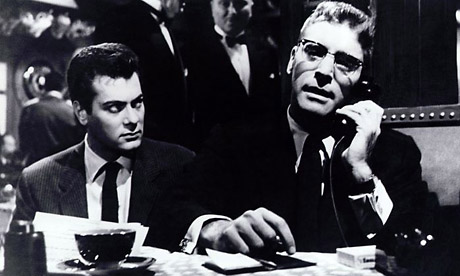
http://derekwinnert.com/wp-content/uploads/2013/08/Sweet-Smell-of-Success.jpgAfter Network, I want to jump to a classic, underrated movie that is usually considered in the context of Noir, or Jazz; that movie is The Sweet Smell of Success.  While the narrative focus is on that of the small time PR hack played by Tony Curtis, the driving engine of this movie is the indomitable character of J.J. Hunsecker... Played by Burt Lancaster, and based on real life columnist Walter Winchell.  The technology may change, but the dynamic is the same.  J.J. Hunsecker is a Mid-20th-Century Matt Drudge, power mad, and paranoid. Watch this movie with an eye on the relationship between the Media and the political machinery, and watch how personal drama's influence both. 

https://trekkerscrapbook.files.wordpress.com/2013/09/face-00.jpgSweet Smell leads nicely into the thematic inspiration for Network... which is A Face In the Crowd. This movie chronicles the rise from obscurity too fame, of a folksy country singer who ends up with his own national television show. While his public persona is that of all around nice guy, he is in fact an angry, mean drunk. One of the beautiful ironies of this movie is that the folksy, yet secretly angry-mean-drunk is played by Andy Richards, who turned in this performance before he became the folksiest every-man of 20th century American television. This movie captures perfectly how the media manufactures fame, and eats up and chews out the people it uses, and also captures the strange relationship between fame, Media, and politics.  If Hunsecker from Sweet Smell... is Matt Drudge, then the Andy Richard's character in A Face In The Crowd is Michael Savage.

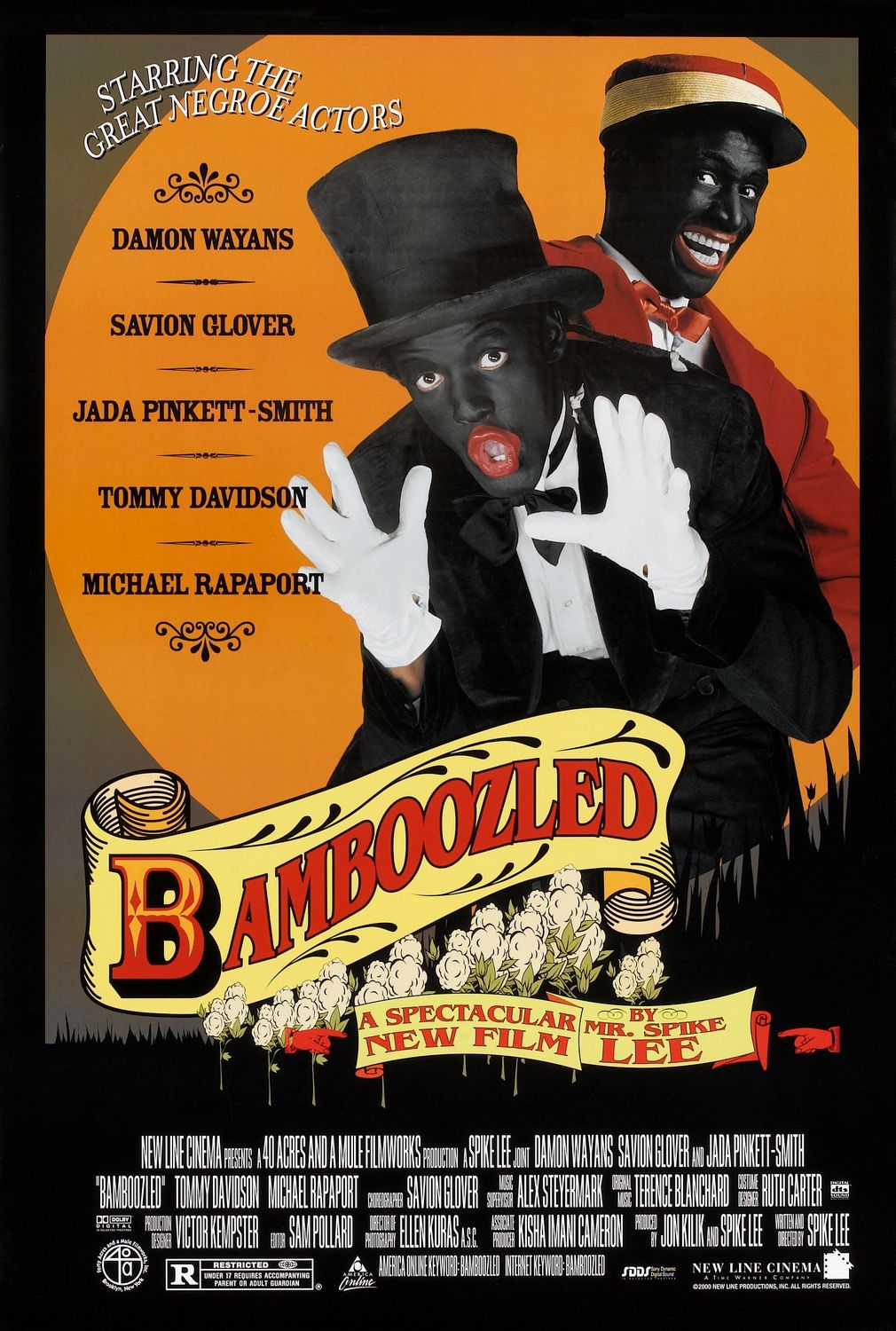
From A face in the Crowd, lets jump forward to Spike Lee's massively underrated classic Bamboozled.  Which is in direct dialog with A Face In the Crowd, and Network... but adds the complicated issue of the media's depiction of race into the mix. This movie is  powerful, and filled with amazing performances. The depiction of race, and issues of complicity and collaboration with the media industrial complex's racism is at the heart of Bamboozled, and it can be painful to watch at times. But it should not be missed.

 It was from the Spike Lee himself, in the film's directors commentary, that I learned of the existence of the movie A Face In the Crowd, and how Lee was consciously making a film in this tradition.  What went unsaid, however, was some of the other cultural references in Bamboozled. Lee didn't give away everything in the cliff notes, and one of the biggest mysteries for me in Bamboolzed was the origins of Pierre Delacroix's accent. In one memorable scene, the character's own father confronts him, saying "N****r, where the fuck did you get that accent?"

http://www.headstuff.org/wp-content/uploads/2015/03/bambooooo.pngFor years, I never found an explanation for Pierre's accent. Spike Lee seems to never have commented on it publicly, and neither (from what
I've been able to find) has actor Damon Wayans who turned in an absolutely stunning performance.  In 2013 (at the Noir City Film Festival), I discovered the 1951 Argentinian adaption of Richard Wright's novel Native Son, starring non-other than Richard Wright himself. And it it, he has a unique, idiosyncratic, and vaguely European accent that is clearly the inspiration for Pierre Delacroix's accent. Mystery solved! Given this accent would have been completely out of place for the character Wright was playing, I can only assume it was in fact his  actual accent, and not an affectation for the film... though I would love to find some recordings of the author to confirm this.

http://www.noircity.com/img/nc11/still/Native-Son_still_horiz3.jpgI am sure there some who probably took this Richard Wright allusion for granted, but I feel like its an obscure enough tidbit that it should be mentioned... and I've never seen it mentioned anywhere, in any conversations about Bamboozled, Damon Wayans, or Richard Wright.

Please let me know if there are any other films or TV shows that fit into this cycle of media and political criticism. As I alluded to above, I'm painfully familiar with Newsroom. :)

Thursday, January 14, 2016

Yet Another TFA Review: (Spoilers)

My favorite part of the movie was the Musical cue, when Han Solo died.

I spent most of a month trying to figure out where I heard it before. Upon my second viewing, about ten minutes after Han died, I realized it was from Cemetery man.

Check it out:

Cemetery man Score:

Han Solo Death scene:

pretty cool, right?

I'm pretty sure this means that a zombie Han Solo is going to come back at some point.  I mean, that's the only thing that makes sense, right?


Friday, November 13, 2015

On Statues, History and Community...

Let me make something absolutely clear. I will never tell someone what they should or should not be offended by.  I also feel that a larger,  more inclusive and welcoming tent is a better tent, and that any changes that make the tent more inclusive are generally good. Got it?  Good. I don't want anybody to misunderstand where I'm coming from, though Goddess knows someone probably fucking will.

Have you out there ever been really angry at Conservative right wingers in america?  Okay, let me refine the question. Have you ever felt uncomfortable critiziing the policies of the Obama Administration because the other people critizing him are raving fucking lunatics screaming about Muslim Manchirian Candidates and socialist FEMA trailers?  Seriously. Its hard to be a left leaning critic of the Obama Adminstration because MOST of his critics are fucking crazy, and you face the real danger of getting lumped in with the crazies.

I feel like that right now. Because I have an opinion on the relevance of the World Fantasy Award trophy, but the REASONS for that opinion have little in common with the kind of rabid culture-war/Sad Puppy/GamerGate confluence that has included grandstanding, bloviating, death threats and other horrible fucking things.

Most of the rhetoric from people opposed to changing the award statue do NOT seem to interested in talking about why a silly statue, based on a silly sketch by Gahan Wilson might be important or relevant to 21st century Fantasy literature.  Instead they want to behave like spoiled children who have had toy taken away from them.  Fuck you and all you spoiled, entitled fuck-ups who have derailed any meaningful conversation about this. You are the reason we can't have nice things.

And one of those nice things is the ability to have a conversation, to politely disagree, and to be willing to accept the choices made by others, even though you disagree with them. 

Your rhetoric, and your threats, and your animosity and resistance to change do nothing to make the Fantasy genre and the community that has grown up around it better, in any aesthetic or moral way.  You are all Cthulhu cultists who would rather destroy the world instead of seeing it change. You are the problem.

But there are always people like you. It is in your nature. And the rest of the world will move on, and you will fade into the night, and be remembered poorly, if at all.

The people I don't want to fade away are the people who created the world fantasy award.  They helped create something good and lasting and important to the broader literary community. I want the judges from years past, and the adminstrators, and the board members who have shepherded this unweildy mass of craziness from year to year, and decade to deacde to be remembered, and respected for their contributions to to the community.

And I would like their reasons for doing things, and the icons they chose, and the shit that was important to them to be remembered and respected in its proper context.

The first world fantasy convention was held in Providence, Rhode Island, as a tribute to HPL . The people who attended, and helped create the award were inspired by WEIRD fiction as much as it was by High Fantasy. "The Extruded Fantasy Product" craze had not yet come to dominate the publising industry, and the label "fantasy" was still a very big-tent label that encompassed all the "weird fiction"of the 20th century.

Some contemporary commentators don't see the connection between horror, and fantasy fiction, and that is just one more reason why this history should be remembered. I often hear "what does horror have to do with fantasy" and it is a conversation that I would like to see carried out in a respectful, wide ranging way -- contemporary weird fiction and horror fiction writers are a very important part of the Big Tent that I spoke of earlier. I hope in the wake of the currently ugliness, this important history... of the award, of the genre, and the people who created the award is not lost or dismissed.

Over the course of my professional career I have worked with and published the work of many people who were involved in the Fantasy community in the 70s, when this award was created. I invite anybody who has personal recollections of those conventions to contact me, publicly, or privately, and please share this history. 

I am not interested in getting into a shit-slinging contest with anybody. I am not interested in attacking this decision, nor the people who made it, nor the people who advocated for it. I'm intersted in the history of the Fantasy genre and the people who helped shape it. I would love to see a host of primarly source materials come to light. Convention reports and Convention histories. Fan histories. Writer's auto-biographies (published and unpublished) and their first hand observations. As anybody who attends world fantasy knows, it is a secrete carnival of folks who LOVE fantasy fiction, filled with circles within circles within circles. The world Fantasy convention that I go to is not the world fantasy convention that other people go to. And that is part of the magic. And this applies to the literature as well. The stuff that moves me may not be the stuff that moves others, but it is all part of a larger tradition.

These are the types of things that I would like everyone to remember. These are the types of conversations I would like people to have. The shit-slinging cultists who just want to destroy everything should be ignored until they fade into the night.  But don't let the productive and important conversations about our genre's history go away or be forgotten. Remembering and talking about this tradition honors the history of the genre and the people in it far better than a single face on an awards trophy.

Monday, January 19, 2015

Course topics: eras and themes

Chronological Examinations of Science Fiction:

Pre-pulp SF, and the early Gernsbeck Years
(Wells, shelly, Jules Verne, ??, Amazing)

Planetary Romance and the later pulp years
Burroughs. Burroughs Burroughs. EARLY FANDOM.

Golden Age of SF
Camble/astounding. House writers and the big 4. Camble ideas as written by various house writers (mirror themed novels). Non-astounding Golden Age material. Compare US to British in this era (very different mix. Also, Orwell, and non "genre" science fiction of era).  Serial Structure... or why those golden age novels are structured the way they are. Fix Ups.  Transitions from Fantasy markets to Science fiction markets (How Pern and Darkover became science fiction). Fandom.

The New Wave
Early Galaxy deviations from the golden age norm, and other new Wave Anticedents.  Feminist SF. New worlds/morchock and Harrison.  Changing standards of paperback publishing (more explicity sex allowed) and now that fueled the later half of the new wave period.  Again, not differences/similiarites in Britsh/American SF during this period. Fandom.

Cyberpunk
Gibson's first published shorty story, Fact Sheet Five, through the publicaction of Snowcrash, which offically ended the "cyberpunk" era. Cover some antecedents. (brunner?). 

Trends in Modern SF (The last 30 years):
New Space Opera, Dystopia, Steampunk, HardSF Renascence,  and other big fat reprint anthologies

Thematic and other ways to look at SF


Young Adult and juvenile Adventure Science Fiction:
 Tom swift to Heinlien to Suzanne Collins

Feminist Science Fiction Revolutions
The Language of the Night (Le Guin, 1979) and How To Suppress Women's Writing (Russ, 1983).


British Science Fiction Traditions and trends
Orwell, brunner and Ballard, with Whindim and others.  Banks. New Space Opera.

Utopian Traditions: advocacy vs observation
Early pre SF utopian Novels, Rand, KSR, etc etc 

Dystopian Literature
Brave New World, Orwell, brunner, ballard, Kim Stanly Robinson, Atwood, paolo.

Apocalyptic and post apocalyptic literature
M. P. Sheil, Walter Miller, The Road, Kim Stanley Robinson

 Alternate History
Turtledove to Kim Stanley Robinson. Steampunk.


Paradox of Other in Science Fiction literature
Disproportionately homogenous nature of Science fiction literature and fandom, and how this is at odds with its immigrant roots and thematic concerns. Writers of Color, and how minority writing communities view Science Fiction. Passing vs not passing (pseudonym)

How Science Fiction won the War and made itself irrelavant.
larger examination of science fictions influence and presence in other facets of popular culture, and how this impacted the literature of SF.

Science Fiction and Imperialism:
British and American science fiction. Steam Punk and Alternate history. Dystopian reflections on empires in decline.

Dying Earth Traditionns in SF
Hodgson, Jack Vance, Wolfe and beyond...


Sunday, January 18, 2015

A Survey of Science Fiction?

Every time someone comes into the bookstore and says they are teaching a class on Science Fiction, I get excited. And just about every time I talk to them, I end up sad and disappointed. Either they have a very narrow and skewed vision of what science fiction is, or they have very little real experience with science fiction literature, and probably know less than their students. 

I'm not trying to be catholic or anything... but words have meanings. Even words used to described science fiction.  When you say "Speculative fiction is real, and Science fiction is not..." I get concerned. When you say "Hard SF... Like Robert Heinlein" I get REALLY concerned.  I know there's plenty of back and forth discussions about terms and labels and meanings... but there are some very real, and useful classification systems that have proven to be valuable in creating a shared language to talk about science fiction, or have at the very least have been beneficial in terms of sparking debate and critical dialog.

So instead of bitching about the dearth of quality Science fiction course work out there, I'll try and do something about it.  I  am about to embark on a full set of course work and syllabus, modeled after various English lit programs, designed to convey a complete view of Science Fiction Literature..... A Science Fiction Certification program, if you will. Get this certificate and you should be able to confidently, and competently teach an Science Fiction class. Or at least argue about it online in a really well informed manner.

The beginnings of any English degree is usually the dreaded "Survey" Course:
British Lit 1600-1800, followed by British lit 1800 - 1920. Followed by Modern British Literature.  I'm sure all you English majors remember the bane of the Norton Anthologies, and the undergraduate reading lists...   Survey courses are usually not terribly exciting stuff...

Except... Most people don't have a sense of science fiction as a literature.  They have a sense of the pop culture and movie bits... but science fiction lit is mostly invisible...

First first stop is to gather together all of the "Written as text books" anthologies, and examine how and why they were organized.  I'm leery of a straight chronological overview...  its all well and good to start out with H. G. Wells and Jules Verne... but I don't think they are the best place to START talking about science fiction... The history and prehistory might be a good upper division specialty course, but I don't think it should be the first thing a modern reader with no genre experience should be presented with. Science fiction is a populist literature about the present.  It should be fun. Not dusty and dry and unrelated to the contemporary reader's life.

I remember when The Norton Anthology of Science Fiction first came out there was a huge outcry from SF grognards. "Where was Heinlein" and "This is focused to much on contemporary writers" where the two big complaints I remember.  Looking back, these two things seem to be one of the books strong points, and not weaknesses. (sorry Bob... its true... Your work doesn't age very well.  I'd slot Heinlein into two different SF courses:  "Golden Age"  and "Juvenile and YA SF")

Anyway... That's where I want to start... Anthologies that serve as a Survey of Science Fiction Literature:

  • There was The Norton Anthology of Science Fiction edited by Ursula K. Leguin.
  • There was Age of Wonders edited by David G. Hartwell
  • and There's the Weislian Anthology of Science Fiction edited by Arthur Evans and Istvan Csicsery-Ronay

Who else has attempted to create a "survey course" framework for Science Fiction, via Anthology?  I'd love to hear about any others out there... either contemporary, or older ones.... Getting a sense of the different frameworks to present the genre is what I'm looking for. Barring an actual anthology, I'd love to see course syllabi and reading lists from teachers who have attempted this on their own.

Please pass this query around, and make any recommendations in the comments or send me an email, if you prefer. Right now I'm focused on presenting SCIENCE FICTION... but I'll consider ancillary course work in Fantasy and horror fiction down the line. :)

Tuesday, June 24, 2014

Jay Lake, The City Imperishable, and Me.

So this was hard to write. I've been putting it off for a while.  A lot of people have written a lot of stirring obituaries and remembrances of Jay Lake.  That's not really what this is though. This is more about me. And it seemed pretty crass to write about myself in immediate wake of someone else's personal tragedy. So I waited, and I thought a lot  about stuff.  And then I ran into this picture online, and felt that I had to write  something. Amanda Downum took this picture at Wiscon 30. Thank you Amanda. You photo  helped get off my ass and down to the business of writing and remembering.

Jay lake started out as a colleague, and writer who I was hearing a  lot  about. And then a distant but regular convention friend.  And then he became an author that I published.  And then  he became a disappointed and frustrated author that I published. It was the first time that I had really failed as a publisher.  Sure, I had books that had done worse, but there were lower expectations for those books.  This was a book by Jay Lake... the shiny, up-and-coming-super-star short-story-writer that everyone was talking about. This was supposed to be his amazing commercial debut.  He  was going to be the next China Mieville. And it didn't happen.  And this was the first time I could point to a specific mistake I made that directly impacted the sales in a negative way.
 
One of the reasons Jay went with Night Shade was because we always put out really good looking books.  But Trial of Flowers had a disaster of a cover, and it was my fault. We were ramping up our schedule  and trying  to more books sooner, but our proccess hadn't changed, and we were still producing them the same way we had always done them. There were time pressures and new  artists to work with, and I was in charge of  it  all. And I failed him. It  was a simply adequate piece of art  with a mediocre to  solid cover design, but what really sunk it was somewhere in the communication between the Artist, the Cover  Designer  and Me, the color  profile of the artwork's tiff file got changed to something that wasn't CMYK, and it got sent  to the printer. And when it  came back, the color had shifted and looked terrible.  And  we didn't catch it until we had 5K copies in the distributors warehouse.


Jay never out-right confronted me  about it, but I knew  he wondered why his book looked so bad, while most of  the other Night Shade titles looked substantially better.  And I tried to make  it up to him by publishing a sequel to the book... with the hopes that  I could  turn the sales of the two books around some how. And Madness of  Flowers got  a pretty good looking cover that I was proud of. But I never got the series to take off. And due to some miscommunications  between me and my business partner (and conversatiosn between my businesses partner and a third party) Jay had an even worse experience with Night Shade the second time around.

I had asked to see an early draft of Madness of Flowers, because I wanted to give Jay a hands  on edit. I loved Trial, and was eager to try and make Madness the best it could be.  My partner Jason didn't know this was an early draft, and was complaining to someone about the bloated manuscript Jay had  turned  in. I think the word Unprofessional was used.  This  got  back to Jay who was understandably pissed off about the characterization. If there was one thing Jay was, it was utterly professional.  I had some tense  words with my partner, and I contacted Jay and apologized profusely, but the damage was already done.

We were never close after this incident, and I failed to find a bigger audience for the two City Imperishable  novels.  Jay moved up to a bigger publisher, and over the years he was cordial and professional towards me, but I never felt like I could make it up to him. I let him down. He was the first author who I felt I had failed... utterly failed.

For me, Trail of Flowers was the next Perdido Street  Station.   It was a smart, funny, baroque to the point of grotesque epic novel, filled to the brim with ideas, all executed  flawlessly. The characters were a diverse cast of hilarious over and under achievers.  I  loved that book, AND its sequel. There are passages from it that still haunt  me. There could  only be ONE reason why that book didn't take  off  and become a huge hit, and that  was because of  THE COVER, WHICH I HAD SCREWED UP...  Except....

I  remember having conversations with a reader at  Borderlands. He didn't know of  my connection to the book. We were just two fans talking about fantasy novels. And he said, "yeah... I kind of liked it, but it was just TOO MUCH...  to dark and graphic."

"Really?" I asked. "How  so?"

"Well, the book  starts off  with a dwarf masturbating  to all tall person getting murdered and tortured for his gratification. Later that dwarf  is anally raped  in graphic detail, and the author spends  a lot  of time describing the injuries and sutures the dwarf  needs in his ass.   Then there's the main character.. the one raised and abused by the dwarf? He gets off by torturing people  in his  S&M Dungeon beneath his office...."

"I guess, when you list all those things back to back like that..." I said, trailing off.  Trail  of Flowers  was  a dark book.  It was filled with all kinds of  nastiness.  But I felt it was filled with a lot  of other stuff too, and the Nastiness  sort  of  mirrored the world I was living in...
US run Torture camps in Iraq  were on the news  every night...  So all the nastiness in the book seemed kind of  minor compared  to the atrocities that were happening every day.

In retrospect, I have to think that the horrors that were going on in the world around Jay as he was writing them had a direct impact on The City Imperishable books.  The the setting for those two books was the last remaining shell of a former imperial empire... the city was and its inhabitants were living in a past where they were the center of the world, while the rest of the world had moved on. It  was the crumbling remanent of a failed empire, filled by myopic and self important  citizens who didn't realize their  time had passed. It's  possible these books were attempts to make sense of the America that Jay was living in. I don't think they were ever evaluated in that context, and I didn't promote them or push them in that way either.  When you are in the middle of something, It's sometimes easy to miss the obvious.

And as the publisher, I didn't see the obvious... the obvious fact that while I loved the books, they were a bit far from the fantasy mainstream. Sure, the benchmarks were being moved to the dark and grim side of things... And since them, "Grim Dark fantasy" has become the new black.  But there are STILL a lot of readers for whom China Mieville is just too gross and icky.  The City Imperishable books are a bit further down the icky spectrum. They were too in your face, and gross and dark for a lot of fantasy readers at the time they were published. And that right there is another perfectly legitimate reason why the books didn't find a wider audience.  But the cover... man. That was on me.  I'm sorry Jay.

I ran into Jay at San Diego Comicon last year.  I had heard he was going to be there. We exchanged pleasantries, and I idiotically said "I'll see you later" when we parted, even though I knew I wouldn't.  When Jay first came down with cancer, it terrified me, because Jay was my age.  And he had a beautiful young daughter who needed him. He was a living breathing example of just how cruel and uncaring the universe is. Every time Jay won another battle, and pushed off cancer for another week, or month or year, I cheered for him. I quietly kept up with his battles via the internet. He generously shared his experiences with the world, and I was one of those folks who watched from afar.  I sent him a letter once... a long detailed letter that was filled with my fears of my own mortality. I told him what an inspiration he was. But it was a letter about my own insecurities, so I'm not surprised I didn't hear back from him.

When my own daughter was born, I  thought of Jay's daughter... who I had met once at a Night Shade launch party for Doug Lain's collection. She seemed like such an incredible little girl. Smart, articulate, filled with confidence and wonder. Even during that short time that I met, I could tell that one of the best things Jay helped create was his daughter.  And she was always at the center of Jay's life. Once again, Jay was an inspiration... in this case, he showed me what happens when you work hard at being the best father you can be.

Speaking of inspirations... There is an embedded little Easter egg... an anecdote about The City Imperishable books.  Jay never admitted it, but I'm pretty sure the character  "Jason The Factor" was based in part on my business partner Jason. The Jason in the book was an accountant and money changer and lender... Jason real life  handled  all  the accounting  and sent out all the checks for Night Shade.  Jason in the book had a kinky S&M  torture dungeon below  his office,.  Jason in real  life... well... maybe its too much information... but yeah. Jason liked it rough and kinky, and he had  been known to over share now and again, so I'm pretty sure Jay new about this side of Jason. Was the name "Jason" just a coincidence? Maybe. But I think Jay was a funny, savvy irreverent writer who packed a lot of different things into his prose.

Jay was one of the first friends I lost because I was his publisher. He wouldn't be the last.  And my experience  with Trail... and the reception it received  from some  readers and reviewers... That was an important lesson... about being honest with one's self, editorially. Aesthetic blinders can cause you to misread the marketplace, and make sales predictions and promises that you just can  meet.  But that experience  with the cover.... That  was  the one that really haunted  me.  For  a while  it didn't help... it caused  me to freeze up, put things off  and ignore obvious problems. Being the one guy, ultimately in charge  of and responsible for everything... It was pretty overwhelming at times. Its  one of the reasons Night Shade started hiring staff, and paying people  to be responsible for stuff.  Which led to new sets of problems and stresses.

But there  were many instances...  where, at the last minute, I shit -canned art that just wasn't right, and found something else... or  I didn't settle on a mediocre design... or I just kept working it over and over until the right combination of artist, and concept and design appeared.  I  didn't want to be the guy who destroyed someone's career  with a bad  cover... Because I had felt I had  already done that once, and once  was enough.

Thursday, June 19, 2014

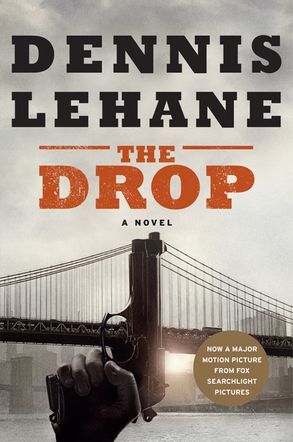
The Drop by Dennis Lehain

The Drop by Dennis Lehain is an interesting cultural artifact. It seems to be a novel, but its a pretty short one. It seems to be the basis for a movie that Lehain wrote.  The packaging on the galley trumpet a movie tie in cover for the book.   Is this book a novelization of the script? Or was the script based on this novel?  A little bit of digging reveals that the script was based on a Lehain short story, and the novel is a novelization of the script, combined with bits and pieces of an earlier novel that Lehain started and stopped.

Ultimately, the books bastard parentage doesn't really matter. Its a gripping, focused little narrative that packs a lot of punch.  There is an efficancy of prose and plotting, with lots of embedded hints and foreshadowings. The characters are drawn well, and often in sharp contrast to one another. Even a couple of throw away thugs have nicely detailed physical and psychological characteristics (The brothers "10").

Like a lot of successfull crime writing, the drop is about broken people living their lives as best they can. Some are trying to make their lives better... and sometimes these journeys of redemption are kicked off by random happenstance.

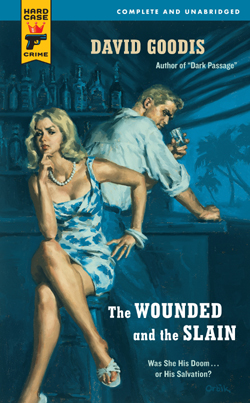
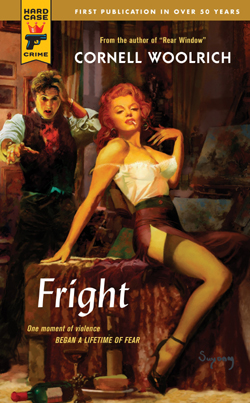
Making hard choices, and Making choices you have to live with, but sometimes can't.  This seems to be the thematic Core of The Drop. Lehain's gripping, yet starkly drawn character sketches fill out a modest plot that is less concerned with who done it and more concerned with putting humpty back together again. So yes... that does make it the perfect little crime novel... a novel that would not seem out of place on the dime store racks, next early 20th century crime noir masters like Cornell Woolrich and David Goodis.

My only complaint is that this book will have a movie tie in cover, instead of some retro-pulpy-noir piece of awesome, the way Hardcase Crime does... Maybe the limited edition hard cover will feature some throwback artwork? Hopefully?  One can dream...


A Goat In White Van

I first discovered the work of John Darnielle via his band, The Mountain Goats; Specifically, their album Heretic Pride. That album combined a mix of literary and pulpy pop-cultural influences that immediately spoke to me, and suggested that John Darnielle and I were, if not kindred sprits, then at least drinking deeply from the same cultural wells. I spent the month after hearing this album trying to tell everyone I knew about this "new" band I had discovered, only to learn that 1) everyone had already heard of them, 2) their two upcoming shows in San Francisco were already sold out*, and 3) John Darnielle was so damn cool that he was in a video by one of my favorite hip hop artists... Damn, even Aesop Rock had already heard of John Darnielle and the Mountain Goats..

So when i discovered that John Darnielle had a novel coming out, I moved heaven and earth to get an advanced copy. Actually, I just asked the manager at the bookstore I work at to ask for a copy from the publishers sales rep, but that doesn't properly convey the level of anticipation, or frantic desire on my part, so lets just stick with "moved heaven and earth." I was finally going to be out in front of the John Darnielle cultural curve. Finally!

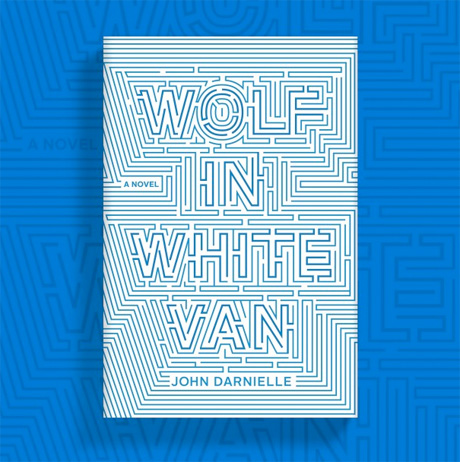
The galley of  Wolf in White Van has one of those designed covers that is positively blinding. I get what they are trying to do... but I don't think it does the book any favors. It's clever in a way that established best sellers can have clever covers, but IMO, this is not the cover you want on a debut novel. I hope I'm wrong in this regard, because this novel is brilliant, and deserves to find a very large group of readers.

The novel is a slow, stately reveal of a character, Sean Phillips who has suffered a horrible disfigurement.  As we move forward through the narrative, Darnielle reveals more and more of how and why the chacrater ended up the way he is. There is a complex flesh back structure combined with a meta-narrative of sorts that is related to a mysterious game called Trace Italian. This game, and various bits of the characters past emphasize yet again that Darnielle and I have been drinking the same cultural kool-aid for a some time.

The character, and settings spoke to me as painfully real, in ways that remind of of Junot Diaz's The Brief Wondrous Life of Oscar Wao I recognized the painfully awkward and lonely protagonists of Wolf in White Van, and the interior worlds they inhabit. I recognized the flat surfaces of the external wold they try to live in, and the tentative joy when those exterior worlds sometimes take on three dimensions.

There is nothing overwrought or purple about Darnielle's style, and nothing twee about his plots and characters. There is a simple intensity, and a playful reveal of details that engenders the feelings of a burgeoning romance and courtship. We the reader are slowly finding out more about Sean Phillips and the world he inhabits... and like many romances, there are no guarantees we are going to like Phillips when we finally learn all of his secrets, but the journey is memorable and exciting.

I was very impressed by the narrative's continuous parade of MacGuffins and solutions to the core mystery of the novel. There was an intensity to the novel's slow reveal that belied the skeletal plot. And the meta story telling embedded in the Trace Italian game expertly interwove and suggested relationships between character motivation and author intentionality, and served as a possible Rosetta Stone to some of the novels questions. The culmination and final reveal of the novel exploded with an emotional inensity equal to that of some of Darnielle's best songs.

This is a character driven novel, with a minimal plot. And as I suggested, the tension in the novel isn't about what is going to happen, but a slow reveal of what has happened, and why.  Frankly this is a tough type of narrative to pull off, but I think Darnielle manages it expertly. Given that the frisson of this work involves organically discovering the mysteries embedded in the character's life, I would urge readers to dive right in, and avoid reading summaries and plot descriptions. Its an amazing novel, and I hope Darnielle continues to prose writing. His earlier effort in meta-textual prose/rock criticisms, Master of Reality is on my to read pile, and I'm really looking forward to it.

Wolf in White Van comes out in hardcover in September of this year.


*Six months later, the Mountain Goats returned to San Francisco and played the Filmore. I got tickets the day they went on sale. The funny thing about this concert was that they played almost exclusively from Heretic Pride.  The audience kept calling out for songs from their extensive back catalog, and the Mountain Goats kept playing tracks from the new album... it felt like the show was just for me, because I didn't know any of the older material... but I knew every track on the new album by heart.

Sunday, April 6, 2014

Raging Against the Cages of Our Own Unhappiness

I decided I need to start writing these things again, because it seems like I've only been writing when someone dies. And that's a piss poor reason to write something down.  It's all regrets.

As one ages, it seems like life is full of them.  Small ones. Big ones. Some regrets are like a piece of corn stuck between your teeth... annoying, and recognizable, but something you can live with. Other regrets haunt you like a demon-ghost from a Joe Hill novel. It's the curse of aging -- though I suppose there are some people who aren't introspective enough to have regrets of the sort I'm talking about.  Either way... whether it be from a long life, or from introspection, regrets are a queer sort of badge of honor. If you don't have them, you either haven't had much of a life, are a thoughtless idiot, or are dead.

But what got me putting fingers to keyboard today was an afterword to a novel. Joe Hill's Heart Shaped Box is a novel filled with Rock-N-Roll. And in the afterword of the deluxe limited edition published by Subteranian press, he talks a little bit about his rock-filled youth.  And he says something that resonated with me; "...for a whole subculture of lonely, angry, imaginative kids, loud music is the hammer they use to bash at the cage of their own unhappiness"

I remember listening to a LOT of loud music... much of the music described in this afterword of Heart Shaped box is music I listened to as a teen. I had a very loud stereo system that I had lovingly cobled together from purchases made with saved birthday and Christmas monies. I had a few hundred slabs of vinyl to go along with several more hundred CDs, because I'm that damn old, and because middleschoolers should not be allowed to join the Columbia House Record of the Month Club (I think I'm still paying off that bill). I remmeber most of the album covers. And while I don't remember the songs consciously, if one comes on randomly in the background, I will find myself singing along to the words, which have been hidden away in my brain for over 30 years, randomly escaping when a song comes begins playing.

Memory is a weird thing. I don't remember what I was angry or unhappy about. I mean, there are the general things like "nobody likes me" or "I'll never get laid"... But I had a small group of friends that I got along with. And weirdly enough, I sort of kind of managed to get laid in the summer between my junior and senior year of highschool after meeting someone at a George Thorogood concert, while spending the summer in Minnesota with my natural father. So clearly my life wasn't Terrible.

But man. I was angry, frustrated and alienated pretty much all the time. hormones and whatnot... the usual cliches can be pointed at.   I remember thinking a lot about suicide in the 6th grade... Mainly I remember because something I wrote in a school journal got back to my mother, and she had a pretty serious and heavy intervention in her young sons life. So it never really got much beyond the idle "scribblings in a notebook" phase of suicidal thoughts.

I remember describing myself as Melancholy... eventually I found a great self-involved first-love tragedy in college to get really weepy about, so that helped. I think maybe my personality and/or view of the universe demanded that my first love be a tragic one.  It was pretty clear in retrospect that we weren't very compatible. But I manged to drag that train-wreck of a relationship out for almost 3 years, and flunk out of college in the process.  Sorry about that, A.  I'm sure you weren't a terrible person. I Hope your life went well. Etc etc.

I remember a line in a Nick Cave monolog, where he described his early life in the punk band The Birthday Party. He said something to the effect that it was a lot of work, being angry all the time.  This is very true. And the anger, frustration, and (in my case rage) of adolsence is an all-consuming rage that is simmering in the back of your consciousness all the time, infecting everything.

Maybe the trick of growing up is to somehow forget about it. To ignore it, at least for a ittle while. The slights, the dissapointments. The frustrations. The self loathing, and the loathing of others... if you can just, for small periods of time, forget that stuff - maybe thats what it means to be an adult?

I had an extended period of re-adolesence. Post 911 america reawaked my inner rage-demon, and I found myself crying and screaming and getting angry pretty much all the time. I probably came closs to having a stroke, as at one point my blood pressure was 140 over 220.  They took my blood pressure in my other arm, because they thought maybe a clot was causing the blood pressure in one arm to be abnormally high.  That kind of blood pressure is a symptom of some serious rage.

Speaking of Rage... that novel by Richard Bachman (AKA Stephen King, AKA Joe Hills father) was one that I read in middle school. It's an interesting perspective, being young, and looking up at characters who are older than you*. I remember being fascinated/terrifed by the novels depiction of highschool life, and at the same time I was weirdly comforted by the confirmation of my basic expectations of life, and school -- that highschool would be just as shitty and awfull as middle school and grade school had been for me,

The protagonist being institutionalized at the end always had a strange kind of appeal... If you just flip out and do something horrible, then you no longer have to worry about anything/everything. I do clearly remember thinking, even before reading Rage, that maybe, just maybe, being hospitalized or imprisoned wouldn't be all that bad because all the social pressures that seemed to be rearing up and intimidating me would be removed. A simpler life. Rage (the novel) was an articulation of that particular preadolescent fantasy... Of course I clearly didn't understand that institutional life is just more of the same kinds of social pressures, just in a pressure cooker, and deformed to something even uglier than your average middle school/highschool terror dome.

The movie Fightclub seemed to have been a movie created just for me. If you don't get why the movie worked, or what its appeal was, than you never experienced the rage and helplessness that many, many people have. It was the cinematic equivalent of Loud Rock Music. Of course, Fight Club was like Milton's Paradise lost... It reveled in the exploits of the devil, and got the reader all fired up by identifying closely and clearly with the anti-hero protagonist, but the narrative was wrapped up in a neat little bow that said "But that's crazy, of course, and you shouldn't do that." It's the narrative technique that wraps up all socially acceptable anti-hero pornography.

A person's reactions to Fight Club, and to the Columbine shootings are a perfect Rorschach test. I totally understood the impulses behind the murderous actions of those lost, angry teenagers. I and a lot of my post-college friends kind of shrugged and said "yeah... I'm surprised shit like that doesn't happen more often."  And then, tragically, it did start happening more often.  I was always surprised to find there were people who just didn't understand what compels angry young teenagers to do what they do. Clearly those people did not grow up listening to Suicidal Tendencies "Institutionalized."

From 2001 until 2011, I was pretty clear about what was making me angry all the time; The atrocities being commmited in my name by my country's millitary. Or at least I thought thats what it was. Tellingly, I spent most of that time not speaking to my natural father. His alcoholism pushed buttons in a way that finally compelled me to just cut him out of my life, so i had a host of unresolved shit, swirling around, and an excuse to act out in anger. I mean fuck... if you weren't angry during the Bush regime, you weren't paying attention.

That's a paraphrase of something I heard in a documentary about The Weather Underground; Do I understand why people strap on suicide vests, or blow up buildings. Yeah. Moral indignation and outrage are excellent things to wrap one's rage and unhappiness in. I used to joke that if it wasn't for internet flame wars and the release that my heated online rhetoric gave me, I would be up in a tower with a sniper rifle, because HOLY SHIT LOOK AT THE WORLD AROUND YOU, WHY AREN'T YOU FURIOUS??!!! And while true to a certain extent, when I said shit like that.... I was totally channeling my inner 13 year old.  I was channeling that young me, who didn't know how to ignore the constant white noise of pain, and anger and rage and unhappiness that is a part of our human condition.

I don't know if one state is inherently better than the other... being able to shut off the noise?  It certainly seems necessary if you are trying to raise two small children. I don't want them to be filled with rage. I want them to be happy. I don't want them to be ignorant of the world around them, and I hope they grow up and try and make the world a better place. But if all they are is happy, I won't complain. Because being a slave to your rage isn't any way to live.  I struggle with the small stuff every day.

I get irrationality and disproportionately angry all the time. And when I do so I make the people around me unhappy and uncomfortable. I count backwards a lot. sometimes from 10. Sometimes from 100. Sometimes my mind races along and is wrapped up and turning in circles. I replay conversation, and hash out imaginary conversations with people, trying to justify my rage or anger or overwheling sadness and helpnessness... trying to convince myself that these racing hormones and flowing endorphins are real and justified and I'm NOT FUCKING CRAZY, JUST ANGRY LIKE ANY RATIONAL PERSON WOULD BE. And when I'm in that state, I count backwards a lot to try and shut down my mind, and try to get it out of the groove that it is stuck in.

I think that loud angry music of my youth was the counting backwards of my middleagedness. I'm reminded of a quote that resonated with me in my angry youth. "It's better to Reign in Hell than to serve in Heaven." You know, that classic quote from mythologies greatest rebel, Lucifer The Morning Star. In writing this, I feel a little bit like that character from pulp fiction,  who has been quoting that Ezekiel verse his whole life, but when he tries to make a significant lifestyle change, he find himself reevaluating the meaning of the quote.

If Heaven is happiness and a perfect world, perhaps the price of achieving that perfect happiness is too great.  Maybe I can let go of my anger and rage, and just be content ruling over hell -- an imperfect place with problems and ugliness and frustrations -- but a place where I am not a slave to my rage. In order to achieve heavenly perfection, I have to be a slave to my emotions, and never be satisfied with what I actually have.  I'm reminded of another quote that has also resonated with me. "'Perfect' is the Mortal enemy of good enough."

Perhaps this seems a bit like settling for less, or for justifying failure, but snarky critiques like that seem very adolescent. Is almost-heaven good enough? Every individual has to decide for themselves.

Yours in introspective rage,
Jeremy

*For example. Did you ever watch the Movie Bull Duhram?  The Costner character seemed SO COOL when I saw the movie as a teenager... world weary, yet wise, and wry and funny. When I watched the movie for the first time in 30 years, my reaction to the character was very different: He seemed to be an angry, jealous frustrated jerk who spouted platitudes while pretending to be the Buddha. Maybe that's the genius of that movie, and other narratives like it. The character can be both things to the same reader/viewer, at different times of ones life.

Thursday, March 20, 2014

Lucius the Story Teller

Lucius was a great story teller. To have spent time with him was to have the boundaries of reality and narrative merge into something magical.

The man was all about stories. Big tall tales.  He liked to poke fun at the science fiction community for having dried up and cleaned up... "You think SF conventions are crazy now?" he asked me rhetorically...  "Back in the 80's there was all the booze there is now, but lots of money, and lots of drugs!  King's agent would leave bowls full of pills out at World Fantasy Room parties....  I once did cocaine off of William Gibson's nebula award."

Truth? or bullshit? Or some combination?  It's hard to know.  He told me about smuggling heroin from Afghanistan back through Europe... about stowing away on a freighter and getting off in Vietnam during the Vietnam war, and getting high in time square porn theaters during he 70's. He had  a great story about having buried a stash of heroin in the woods, only to come back for it later and find a bunch of cub scouts camped out where it was buried.  More stories... Hilarious stories. Tall tales, from a man who was larger than life.

Lucius once wrote an entire novel, and then had his computer crash and lost all of it. He re-wrote it from memory.  He cavalierly dismissed the hassle, (which cost him two years of writing) by suggesting "That's okay. It was better the 2nd time around. I only remembered the good bits." This book was A Handbook of American Prayer.

He lived close to my former business partner, when Jason was in Portland and Lucius was in Olympia. I knew I had finally become a legitimate editor and publisher when we were buying illicit drugs for one of our authors. I felt like a character out of one of Lucius's tall tales.

Lucius Shepard turned me on to the writing of Kem Nunn. That in itself would have been worth a lifetime of small favors and friendship.

I'm proud to have published several books by Lucius, and prouder still to have sent him on a west coast author tour. When he hit San Diego, my 21 year old sister was his driver, bringing him from airport to hotel and to Bookstore, and back again. He asked her if she knew where he could score some acid, and asked me the same question when he got to San Francisco.

When Lucius stayed at our apartment, he would watch martial arts fight videos with my wife and talk about various forms of martial arts.... He was a huge fight fan. Marital arts. MMA, Boxing... all of it, and a huge fan of college football, and those topics were ones that he would expound upon at length on the old Night Shade message boards.

He was a monster on those message boards, and the internet in general, filled with passion and fire and rage. We survived the Bush Regime together. Knowing there was someone who was just as frustrated and filled with anger about the state of the world as I was  made me feel less alone in a crazy-bleak-fucked-up time.

He often let his passions get the most of him. I remember when Kage Baker swore off the internets after she got into a huge flame war with Lucius about the catholic church. That was a weird week.

He wrote a movie review column for F&SF, that were collected up by wheatland press. They demonstrated a depth and breadth of knowledge about both world cinema and Hollywood that would put most self described cinephiles to shame.

When I knew him, he was always in poor health, but he always affected a cavalier and easygoing attitude about his troubles.  When his poor sight made it difficult to read what he wrote, he would simply INCREASE THE FONT SIZE... I would get manuscripts set in 66 point font. He never complained... or if he did, it was part of a story and narrative, so it didn't SOUND like complaining.

His writing was divine. He experimented and screwed around with format and style. He had keen insight into the human condition, and we was marvelously noncommercial in his choice of subject matter and format.  And, according to him, it was all a lucky accident that he became a writer at all.

He told me a story about how it happened. He was in a very bad place, and watching a lot of evangelical preachers on television.  He said he was in such a bad state, that he would stand up, and lay his hands on the TV, in order to better commune with God, or the preacher or whatever.... looking back, he wasn't sure WHY he was doing it... He just had a memory of doing it.

His wife  at the time submitted an application on his behalf, to the Clarion writers workshop without his knowledge... "Go out there and write, because you're going to go crazy if you stay here" was how he characterized her words and actions. At Clarion, he met legendary SF editor Terry Carr. Carr was editing a line of debut novels at the time, and asked Lucius if he had any novel length projects in the works. Lucius said he lied his ass of and made something up on the spot. After leaving the workshop, he actually wrote enough of an outline and sample chapters to convince Carr it wasn't BS, and the rest was Science Fiction History. 

Was this origin story a little to neat, and perfect?  Perhaps. But it's the story he told me.

Fuck-it-hell-Lucius. I'm going to miss you, and the world is a much poorer place with you not in it. Tell me just one more story...  I'll believe every word.

Tuesday, November 26, 2013

One of the Best Writers You've Never Heard Of Has Died


Today I found out  that Joel Lane died. Mark Valentine shared a very personal account of Joel and his work, and we are very lucky that Mark has chosen to turn his grief into an eulogy that helps us know Joel and his work a little bit better. Thank you Mark, for sharing your personal stories of Joel.

I only knew Joel through his fiction, and through the brief professional relationship we had. I published his short story collection The Lost District and Other Stories. I was always frustrated that I wasn’t able to find a larger audience for his work, but his fiction had an unrelenting quality that is sometimes the hallmark of both great work, and uncommercial work. For a good example of what I’m trying to convey, check out both the Publishers Weekly review, and Ray Olson’s Booklist review of The Lost District over at it’s Amazon page. These are reviews by people who have been made extremely uncomfortable by Joel’s work, but can’t help but respect (and sing the praises of) the writer who managed to invoke those feelings with just a few words on a page.

I am very proud to have published his collection. Indeed, one of the few perks of being an independent publisher was being able to follow the ones heart, instead of just following the market. And this book is one of those books that I have a personal connection too. I first discovered Joel’s work in the pages of Karl Wagner’s Year’s Best Horror anthology, and regularly stumbled across his work from that point on. This was all long before I was an editor, or even thought of working professionally in the field. I was a fan. And I was a fan of Joel Lane’s short fiction. I’d see it every year… in the magazines… in the original anthologies, and in the best of the year anthologies. Many years later, when I found myself editor in chief of a genre publishing company, I  jumped at the opportunity to work with Joel… to follow up his World Fantasy-award nominated short story collection with a new volume of his amazing, moving, troubling work… to help continue that long, ongoing genre conversation, and to make sure that Joel Lane's name was a part of it. I was ecstatic.

Hopefully we can take some solace in the idea that (to steal a phrase from a different genre) the circle will be unbroken.  Maybe, like I did,  a new generation of readers and writers will find and be inspired by Joel's writing. We may be in a small, dark little corner of the literary world, but in that corner, Joel was a giant. I feel very lucky to have known him and his work.

Obviously, this long view can’t ease the immediate pain of loss for those who knew him personally. Mark Valentine shared some very personal remembrances of Joel, and I’d like to share one of my personal remembrances too.

As Joel and I began going through his uncollected fiction and began imagining the shape and form we wanted the book to take on, he suggested we name it after his story “The Country of Glass.”  Due to my father’s alcoholism I had had a very negative and visceral reaction to that story, and while I was kind of self conscious about my reaction, I told him I’d prefer to not name the book after that particularly story, and explained why.

He immediately apologized to me, and offered to remove the story from the book altogether. I assured him that he owed me no apology… that the visceral impact his fiction had on readers was what I loved about his work, and that the story needed to stay in the collection.  And while we brainstormed over alternate titles, he was a perfect gentleman when he shot down several of my completely unserviceable suggestions.

Around the time The Lost District was published, Joel suffered a very personal and tragic loss… the sudden and unexpected death of his father. The circumstances of that death forced Joel to be continually confronted by the details of that death long after it happened. The world kept rubbing salt into that emotional wound. 

It was during this time that I lost contact with Joel, and if I’m honest with myself, it was in part because the very real loss that Joel suffered forced  me to consider my own father and the rift that separated us.  I wasn’t able to comfortably deal with these emotions, and Joel’s emotional turmoil mirrored my own in a way that, much like his fiction, made me deeply uncomfortable. But Joel personal grief, as well as his fiction played an important roll during that period of my life. It helped me realized that I still have a father who is alive, and accept that though that could be a burden, it was also a blessing.

Thank you for these insights Joel. I wish I could have somehow conveyed this to you when you were alive. If we are not careful, our lives can easily be subsumed by mounting piles of regrets. Of things we wish we should have done. I wish… I wish. And that is a terrible, terrible irony. Because the crushing weight of regret and how it shapes us is one of the facets of the human condition that Joel regularly grappled with in his fiction.
 
I wish you were here Joel, so I could tell you one more time… Your work is  important and powerful, and I thank you for sharing it with me and with the world.


Wednesday, June 5, 2013

First week of my new life... (MANUSCRIPTS! SEND MANUSCRIPTS!)

The first week of my new life is a lot like my old life. Poeple are asking where their money is. somethings never change.  :)

But now I can say "Someone else is responsible for that and I've been told they are on top of it. If you haven't heard from them in a week or so, let me know, and I'll forward your information to the right people."

Other things that don't change, but sort of do... I've got a lot of production work that I need to process and hand off. Hopefully over the next few months, my work on the the production side of things will start to go away. Maybe I'll still be involved in some of the art direction decisions, or maybe I'll just be a guy with opinions that are sometimes listened to, and sometimes not. We'll see.

First and foremost though,  it seems like I'm back to acquiring books.  So I'm offically putting out the call for submissions.

If you already submitted something to me in the last 12 months and haven't heard back from me, please send a query. SF, fantasy and horror. That's what I'm looking for. It has to be good of course. Please querry first.

For now, I'm only open to agented submissions, or if you come with a reference from someone I know.  A lot of Night Shade's best titles came in through the transom via a recommendations.  Some even came from random hookups at a convention bar.  That sounds kind of naughty. I don't mean THAT kind of hook-up. I mean randomly discovering passionate, interesting writers at cons, whom I tell to send me something. and then that something turns out to be awesome, and I buy it. It happens. Crazy, huh?  The convention thing might not happen this year though, as I don't think I have a travel budget anymore. We shall see.

At some point in the future, my email address might change... but for the next month, hit me up jlassen@nightshadebooks.com

Query first. But only if a full manuscript is ready.

Monday, June 3, 2013

Fifteen Years of My Life...


So that’s a chapter of my life that has ended. Night Shade Books is now an imprint of Skyhorse Publishing and Start Publishing. I always said that if it ended tomorrow, that would be fine because I was proud of what we managed to accomplish.  I always said that because it always seemed like we were on the verge of going out of business.  That never changed, right up to the end. The number of zeroes at the end of checks increased every year, and that in and of itself was a kind of monument to our success. We started out very small, with very little. And in the end our successes were very big, and our failures were very costly.

For everybody who wants to take shots at Jason Williams and myself for being bad business people, that’s fine. I don’t begrudge anybody their opinion. Obviously, if we had been better business people, we would have ended up with money in our pockets when we sold our company, instead of tax bills that we can’t afford to pay. But the majority of these “bad” business decisions involved being too “writer friendly” - both in terms of royalty rates and contracts, and in terms of many other very author-friendly decisions we made over the years. I won’t bother listing them or going into the details, because even if all of the information were made available to interested parties, it wouldn’t changed the minds of people who have already judged us. In the construction of many people’s inner morality plays, we have been cast us as either outright bad guys or incompetent buffoons or some combination of these two things. Many of the people who made those judgements have done so publicly.  For the record, I'd like to point out several things. 

First and foremost, my long time business partner made enormous financial sacrifices to keep Night Shade running. Whether it was not taking owner-draws on months when cash flow was dangerously low or when it came to investing personal money, he always stepped up and never hesitated.

He will probably be very mad at me for sharing this anecdote, but I know he won’t share it himself, and I believe the record should reflect his personal sacrifice.  In the summer of 2012, when Night Shade had just transitioned from one distributor to another, sales were lower than expected. Returns were 2-3 times higher than they had historically been, and Night Shade was approaching the end of a royalty period with not enough cash on hand.  Jason got money from his father… money inherited from a recently deceased grandmother, and dumped it all into the company. And I’m not talking a few thousand dollars. I’m not talking tens-of-thousands-of-dollars either. I’m talking six figures.  He dumped that onetime pot of family inheritance into the company so that authors would get paid their royalties on time, and so that the wheels would not come flying off during a time when we had made systemic changes which had hoped would lead to a stable company. That was probably a "bad business decision" but he made it without hesitating.

Unfortunately, the distributor change did not result in the kinds of increased sales (and decreased returns) that we were hoping for. Six months after Jason's contribution, we were better off  than we had been prior to the distribution change, but we were still not meeting the goals we needed to meet. But that influx of personal cash from Jason put the company into a position that made it attractive to buyers… attractive in a way that it would not have been otherwise…  attractive in a way that allowed our unsecured creditors to get paid. And by unsecured creditors I mean our authors and production free-lancers.

So every check that gets cashed in the coming weeks exists because off the extremely significant financial sacrifice that Jason made.  I will go further than that, though. Every one of those checks exists because of the hard work that Jason, myself and our employees put into this company, year after year. 

We all worked hard to ensure that every book published was a significant event… Because it was a Night Shade book. We had a carefully cultivated brand that instantly brought attention to the many first novels, mid-list career reboots, and other titles we chose to publish. I firmly believe that not only did we do our best for our authors, but I believe that our best was pretty good.  For some authors, that just wasn’t enough. For others, external events and timing got in the way - the same way it does for every publisher out there. But to all of our authors who harbor a grudge, or feel like we were “a rolling shit train” that "did nothing" to support their books, I’ll take full responsibility for your sales figures. I’m sorry I didn’t do better by you and your work.

We published a lot of authors over the years, and I believe that while some of them would have eventually found publication elsewhere, there are many who would otherwise not have made their way into print, and would not have found the readers that they did.

Night Shade paid a lot of money, year after year, in royalties and advances. And while people in the SF community often heard about the tardiness of some of those payments, the truth is we put hundreds of thousands of dollars into many people’s pockets. Night Shade’s new owners chose to make last years total dollar sales public.  Keep in mind we paid significantly higher royalty rates (30-50% on ebook and 10-12% of cover on print editions), and a significant number of our titles last year did not earn out their advances, so Night Shade  paid out more than just earned-royalties on those sales.  I’ll let interested readers estimate for themselves how much money we paid out. And that’s just to the authors. Don’t forget all the freelance editors and artists we paid last year. And we did that year after year. Last year’s sales were actually a 3 year low for Night Shade. That frustrating fact is obviously one of the things that led to the sale of the company. We could have given up on Night Shade many years ago. But we didn't.

Night Shade kept the train going forward for a lot of years. And money went out to those people who earned it, year after year. It went out to our authors; to our freelancers; and to our employees. And the last thing we did as publishers was to make sure that the money got paid out to the people who earned it. I’m proud of the work we did, and I feel we operated with integrity. I feel we did right by a lot of people, for a long time. I gave 15 years of my life and my professional career to the field that I love. I have nothing but respect and admiration for all the authors I’ve worked with over the years, and I wish them the best of luck going forward.

To our readers who supported us over the years. Thank you. You supported us when we took risks… you supported us when we published challenging books that didn’t fit neatly into predefined categories. You helped spread the word, via many different outlets… be it face-to-face at conventions or online at various social media outlets. You all helped create something that has had a lasting and significant impact on the Science Fiction community and publishing world. Thank you. I’m honored to have helped you find the authors and books that you otherwise would not have found. Putting the right book in the right reader’s hands is hard… but that, more than anything else, is what the hard work of publishing really is. I’m proud to have done it for these past 15 years.

To the new owners of Night Shade: Thank you for taking a leap of faith. I’m hoping that this new incarnation of Night Shade will continue to have a significant and positive impact on the science fiction community.